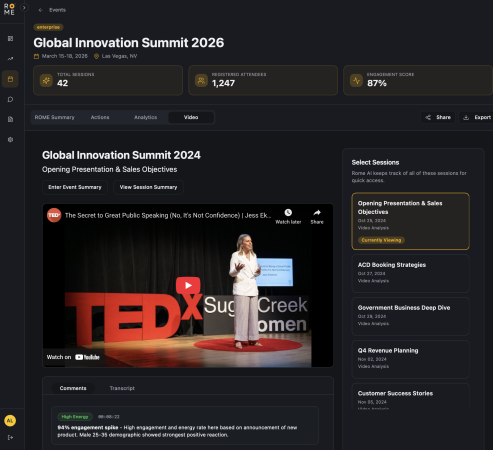
NASHVILLE — What is the real impact of live events? Do they change people’s lives? Do they help attendees understand important ideas? Do they provide tips that people take back to their colleagues to help their teams operate more efficiently?
These are the questions that all show organizers want the answers to, but even with the feedback they receive from post-event surveys, they’re not always getting them.
That’s where ROME Insights comes in.

“We thought that there’s got to be a better way,” Bob Hutchins, Chief AI and Marketing Officer at ROME Insights, said. “The technology is there that you can measure real-time sentiment of content that’s being communicated at a live event, and then you can interpret it and have reports on it.”
Related. Reallusion’s iClone AI Assistant Offers a Unique Animated and AI-Powered Branding Opportunity
In order to do that, Hutchins — who has a background in psychology and AI literacy — co-founded ROME Insights with veteran event technology and experience expert Justin Zebell of No Name Group.
The data analytics startup recently launched ROME to measure the human attention and emotional engagement of attendees at trade shows, conferences and corporate gatherings.
Leveraging AI and Psychology to Measure Event ROI
ROME marries technology and psychology to gain an understanding of how attendees really feel about the content of events — thus helping show organizers demonstrate their true value.
For example, a show could be paying $100,000 for a keynote speaker that no one is actually paying attention to — or worse, attendees demonstrably dislike. On the other hand, a $40,000 speaker may actually garner much more engagement from attendees, making the return on that investment much greater from an audience-sentiment perspective.
To measure this type of ROI at events, ROME captures anonymous, real-time emotional and behavioral signals of attendees. Cameras are placed in a room and focused on attendees to gather information about their facial and body language.
Although audience members’ images are anonymized to protect their privacy, ROME is still able to gather valuable information on body language, micro-expressions and movements, and then leverage a sophisticated AI algorithm to take that data and determine what it means.
Related. AEM to Launch Suicide Prevention Programming for Construction Workers at The Utility Expo
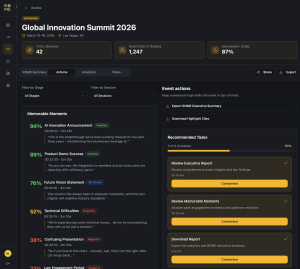
“If you’re watching the video in your dashboard inside ROME, you’re seeing a report that explains when your speaker said this, this and this, at minute 2:47, females in the room between the ages of 30 and 45 responded positively, but you lost males in the 30-40 range at that point,” Hutchins said. “You’re seeing that real-time movement of content and you can then go back as a whole and say, ‘This was successful, and this was not successful.’”
Understanding this success, or lack thereof, can go a long way toward revealing what attendees really want from events, so shows can make content decisions.
“Chief Marketing Officers and Chief Financial Officers are under pressure to justify spending. Financial people want proof, not just antidotes. What we’re really offering is that we connect live engagements to spend,” Hutchins said. “We visualize the room and give real-time response. As a result, those behavioral insights provide a clear understanding of what worked, measurable ROI and memorable impact.”
To get more events industry news, subscribe to TSE’s free e-newsletter on LinkedIn or through your email.