PARKER, Colo. — Larry Kulchawik coined the phrase “the invisible industry” to describe the world of trade shows.
The just-released 2026 Events Industry Council (EIC) Global Economic Significance of Business Events Executive Summary asserted that the industry has a total spend of $1.3 trillion, supports 24.2 million jobs and contributes $3.1 trillion in total business sales to the global economy.
Yet, even with this economic impact, Kulchawik estimates that 60% of people are unaware of trade shows.
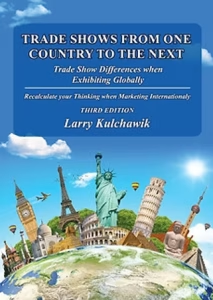
Trade Show Executive sat down with Kulchawik, a leader who spent the majority of his career with Exhibitgroup and has written two books about business events — “Trade Shows from One Country to the Next” and “The Invisible Industry” (co-authored with Bob McGlincy) — to discuss the state of the industry.

FRANCES: What is your assessment of the latest EIC report?
LARRY: That survey, and others that have been conducted by UFI and CEIR, are all correct in their assessments.
This EIC survey went beyond trade shows to cover business meetings. Think about all the business meetings of 10 or more people that are held outside the office — all around the globe.
The numbers from all of these surveys are correct, based on their methods of measurement. In the end, this is a bigger industry than anyone ever imagined.
FRANCES: What’s one of the most-misunderstood trends you’ve seen in your career?
LARRY: In the 1990s, portable exhibits and systems became extremely popular because they were lighter in weight and saved money. I was working for Exhibitgroup at the time. At first, people said, “Who needs those? Nobody wants that lightweight crap.” Nobody realized that this would be the future.
Related. Exploring the History of Trade Shows with Larry Kulchawik and Bob McGlincy
FRANCES: Is the U.S. trade show industry in a vulnerable position right now because of international attendees not wanting or able to come here? How does this compare to COVID?
LARRY: In our industry, COVID actually enhanced digital communication. During the time, companies were still doing trade shows, but not as many people attended. They did it digitally. Because of that period, we actually learned a lot about technology.
International travelers’ fear of the U.S. is serious. With COVID, things literally stopped.
But the good news is: Why did it come back so strongly? Because the need to mingle and the need for face-to-face communication was proven to be necessary.
FRANCES: How are trade shows evolving with Millennial and Gen-Z attendees?
LARRY: It goes back to what I said about digital technology. If both virtual and live are able to take place, they can still participate and it’s still useful. You can still have an experience from your laptop, just not to the same degree as being there.
For live shows, location matters more now than ever before. As Boomers, we just went wherever we had to go. But today, these younger attendees want to go to San Diego, San Antonio or New Orleans. These places have an emotional attraction and get them to consider attending that meeting.
FRANCES: What do you see as the frontier on the global stage for trade shows?
LARRY: Dubai, which will come back. Singapore. Even Beijing and Shanghai.
I think for the U.S., let’s put a bigger convention center in Hawaii and in Puerto Rico. These are attractive destinations and they’re within our territory, and it would keep the money here.
FRANCES: Can you share your definition of a “Eureka” moment?
LARRY: The thing about going to a live trade show is there’s always what I call a “Eureka” moment. You went there with an expectation about something you wanted to learn or find. Inevitably, you’ll be standing at the coffee line, you’ll run into somebody and they’ll tell you about something you’ve never heard of. That’s a “Eureka” moment.
You didn’t expect that to happen, but it happened. And it has always happened at every event I’ve ever gone to. I have always had one or two “Eureka” moments.
It leaves an impression in your mind and it drives you to take action — that’s what trade shows are all about.
To get more events industry news, subscribe to TSE’s free e-newsletter on LinkedIn or through your email.