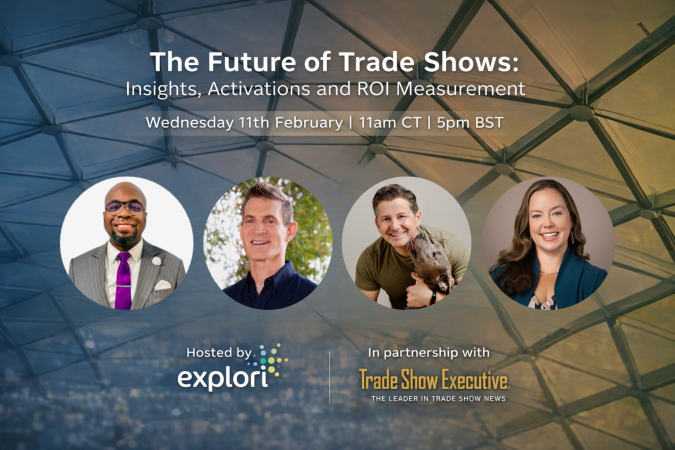
CHICAGO — Explori, in partnership with Trade Show Executive, hosted a webinar this week focused on new models of engagement and measurement at trade shows and live events.
The webinar, titled “The Future of Trade Shows: Insights, Activations and ROI Measurement,” served as a candid conversation between show organizers and corporate exhibit leaders to discuss the challenges and opportunities both face when it comes to creating and measuring ROI.
Featuring Greg Topalian, Chairman of Clarion Events North America; Dean Armintrout, Senior Director, Global Experiential Marketing at Zendesk; Sarah Gannon, Director, Corporate Events at MathWorks; and Emile Davis, Managing Director, Business Development at the American Institute of Architects (AIA), the webinar provided clarity around what kinds of offerings and measurements help exhibitors and sponsors justify their spend most.
The webinar kicked off with a presentation of the findings from Explori’s Channel Insights Report from Explori CEO Mark Brewster, which focused on the changes in exhibitor satisfaction post-pandemic, as well as the drivers of those improvements and how event organizers can continue building on them to enhance their events.
Combining insights from show organizers and corporate exhibitors, the report signaled that there is a strategic shift in event participation happening, with a greater focus on ROI and quality over quantity, and a greater need for data and measurement.
Related. TSE Reveals the Fastest 50 and Next 50 Classes of 2025
Evolving Event Formats and Thoughtful Design
Part of the discussion was focused on identifying what kinds of event programming and formats that show organizers are currently leaning into to help generate more ROI for exhibitors and sponsors.
“For me, the biggest opportunity we have is around human connections. More than ever, people are looking to feel connected to others with similar problems and similar interests,” Topalian said. “I adore hosted-buyer events; those are all about getting the right people connected in a more meaningful way. After two or three days in a small environment, you don’t have leads (at the end of the event), you have friends.”
On the same topic of facilitating meaningful connections, Davis shared that AIA is using technology to up their personalization game to connect attendees with exhibitors.
“What I’m really excited about is a few years ago we implemented really robust AI matchmaking,” Davis said. “For example, if Sarah signs up for XYZ session, she automatically gets recommendations of those exhibitors under those categories. That helps to enhance and helps exhibitors plan better for pre-show, onsite and post-show.”
Armintrout emphasized that matchmaking is becoming critical for trade show organizers to leverage to help exhibitors and sponsors connect with the right customers at an event.
Showing Up Beyond a Booth Drives Value
The corporate representatives on the panel, Gannon and Armintrout, shared that as exhibitors and sponsors, they’re looking for opportunities to connect with executive-level leaders.
“From a trade show strategy perspective, we’re looking to connect with specific types of people,” Gannon said. “You have the age-old argument of ‘Are we really seeing executives on the show floor?’ And, they’re not the ones walking the show floor, so where are they and what are they doing? … Creating those moments where those decision makers are gathering together, and creating that ‘what’s in it for me’ opportunity for them so that I can show up as a sponsor and have exclusive access to that group of people, is going to be extremely valuable to me.”
And these connections don’t have to be designed to happen on the show floor. In fact, some exhibitors and sponsors want to have more structured opportunities to connect off the show floor.
“Objectives are going to vary by company and by event, but it’s not just about a bunch of leads, or at least I hope it’s not, because you have to really dive into the quality. … If those CIOs or executives aren’t stopping by your booth, which they’re not, understanding where they are (is important),” Armintrout said. “We’re looking to event companies to give us that journey; give us some heat maps in terms of where your attendee types go. Where are those C-level executives going? Is it those outlets or networking dinners, and how do we (as sponsors/exhibitors) get access to those.”
Some trade show organizers are aligned with these expectations and are focused on engaging in meaningful dialogue that help determine companies’ objectives and drive greater ROI through customized solutions.
“Thinking about it from a show organizer perspective, and a lot of folks have been guilty of this including myself, we come up with a sponsorship, and we hope it gets sponsored to cover the expense and potentially net some profit on the other side. Those days are gone, and those conversations have to start at the very beginning,” Davis said. “Have that conversation in terms of what their [sponsors] objectives are. Those are some of the areas we’re seeing some tremendous success with, especially around activations and immersive experiences. They want to be a part of it. You’d be amazed how much more flexibility around the budget your sponsors will get once they realize that you’re a true partner and you value and respect each other throughout the whole journey.”
Challenges Around Data-Sharing
Another main focus of the webinar was data collection and ROI measurement. On the conversation around data, it was clear that the information organizers collect from attendees during registration was key to helping exhibitors and sponsors better plan their participation and schedules.
Davis shared that AIA is letting exhibitor needs guide their data collection in registration to better help them obtain the relevant information they need for the show.
“Data is king. It was the most important thing needed for our exhibitors and sponsors,” Davis said. “It starts at the very beginning. Before we open up registration, our exhibit and sponsorship sales team will meet with our marketing team to go through the process as to what sort of data we’re trying to capture. … We get those questions from our exhibitors. We engage our exhibitors on a regular basis, so we have what’s needed to help us capture that rich information during the registration process for them. The key is, from an attendee perspective, for us as show organizers to establish that the expo and the sponsors and the exhibitors are part of the whole entire experience.”
Throughout the conversation, Gannon and Armintrout emphasized how important it is to exhibitors and sponsors to get as much data as possible ahead of the show to be able to better plan how companies choose to show up to the event. Yet, the show organizers on the panel explained that it isn’t always possible to share all of the data they collect with exhibitors and sponsors — and not just because of data privacy concerns and regulations.
“Our promise to you is we will get the maximum number of people in the room and engaged. While we very much want, and the economics of our business is contingent on, sponsors being happy, it can never be at the expense of the attendee,” Topalian said. “Someone in the chat made a great comment there that it wouldn’t be great if we have thousands of high-quality attendees that are just inundated with meeting requests when they want to navigate this experience for themselves. That is just a tricky part of being an organizer because you have two customer groups, and your job is to get both to be really happy. But my default has always been that the audience is the magic.”
Along with wanting better show data from organizers, Gannon acknowledged that exhibitors and sponsors have the responsibility to take action once they get that information.
“I implore all of the show producers of the world to give us better data up front, because it’s going to help us and in the back–end of things in terms of following up. But, we also have to take ownership of this as event leaders. It’s not okay to think the event’s over, let’s move on,” Gannon said. “We have to partner with our sales teams to make sure that those hot leads that were identified are followed up with. Many of the times, those folks don’t even get followed up with, so take ownership over your events and make sure you’re putting in the legwork or assigning it specifically. I know we’re all so busy and that’s a really hard step, but it’s so important, especially when it comes to those whale deals that we could potentially be moving the needle on if we just had that immediate follow up and follow through.”
Measuring ROI Is a Business Imperative
When it comes to measuring performance on event participation, Gannon and Armintrout emphasized the importance of having systems that can integrate easily with the systems that show organizers use to better capture the data exhibitors need to strategize.
“I’d say system integration is probably key, and that goes on both the event organizers as well as the companies exhibiting. Event organizers that don’t give you the API to their lead retrieval system so you can customize it are a challenge,” Armintrout said. “If you can use a third party independently to customize your experience and directly integrate into your CRM systems, then that’s a much easier path and faster path for corporations exhibiting at events on the internal side.”
Important to note is that some exhibitors and sponsors will choose to not participate at events where they’re not getting the data upfront or clear ROI out of it.
“If I’m not showing ROI, if I’m not showing that we’re actually driving business as a result of these engagements, we’re not going to get to go there,” Gannon said. “Previous to (my role at) MathWorks, if we didn’t get contact information from the show producer, we didn’t go. So even up front, if we weren’t getting the data that we needed, we wouldn’t invest in that show. Some people were surprised that we pulled out of some shows as a result of that. But events are a huge business driver right now; we’re taking over the marketing mix and a lot of the heaviest investment from a company is in events. It’s important for us as event leaders to be able to show what we’re getting out of it.”
To get more events industry news, subscribe to TSE’s free e-newsletter on LinkedIn or through your email.