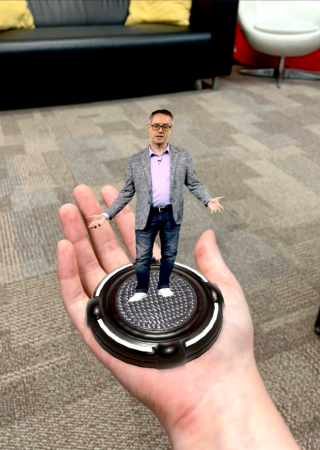
CHICAGO — Augmented Reality (AR) is an interactive, technological experience that merges the real world with digital content.
A popular example of the technology is Pokémon Go, which uses smartphone cameras to place virtual creatures in one’s environment. Companies such as Ray-Ban are also offering AR “try-on” features, allowing customers to virtually test sunglasses, clothes, makeup and more products. Also, numerous business events have utilized AR to create experiences that wow participants.
Christopher Baron, Senior Director of Innovation, Encore Canada, has helped create AR experiences for PwC Canada, the American Academy of Dermatology, the Professional Convention Management Association’s Canadian Innovation Conference, the Canadian Marketing Association and more clients.
Baron connected with Trade Show Executive to share what organizers should know about AR.

ANDREW: How can AR make business events more effective?
CHRIS: Several independent studies indicate that AR delivers improved engagement on multiple levels. Audiences are more likely to engage, tend to have longer dwell times and retain information better when content is delivered with AR compared to traditional media.
ANDREW: How can AR drive value for exhibitors?
CHRIS: We have built a number of activations in the last few years that have delivered fantastic return on experience which leads to better return on investment. The key differentiators are good UI [user interface] and UX [user experience]. When we see mistakes in the UI, we see a reduction in ROI. My best advice is to find an AR partner with experience and case studies to ensure you maximize the value of your investment.
ANDREW: Are there any AR experiences from recent events that you would like to highlight?
CHRIS: Results and data matter when people are willing to invest in new technology for their event. In one activation we ran last December, we saw 75% of the target 1,000-person audience try the experience and 95% complete the entire experience.
Related. TSE Trend Report: Exhibitor-Led Experiences
ANDREW: How do event participants typically react to AR experiences? Are there any challenges, and how are they worked through or avoided?
CHRIS: Surprise and delight is a common term we use. People find new innovative technologies fun and exciting.
However, with any new, discontinuous innovation, there is an aspect of behavioral change required when creating content. There is also an aspect of behavior change for audiences in how they consume content. Understanding where people are in the spectrum of technology adoption and what UI is contextual and relevant to that audience is of paramount importance when designing these solutions.
ANDREW: What are some misconceptions that professionals have about AR?
CHRIS: Confusion between AR and VR [Virtual Reality] is still somewhat common. AR is the overlay of digital content on the real world, while VR is an entirely immersive virtual world, disconnected from the real world completely.
ANDREW: What advice would you give to a show organizer or exhibitor who wants to incorporate AR in their experiences?
CHRIS: Work with designers who have experience in designing specifically for Augmented Reality, preferably also with UX/UI design experience as well.
ANDREW: How have you seen this technology evolve, and how do you predict it will change in the future?
CHRIS: In my opinion, the most significant technology advancement to date has been the standardization of WebAR frameworks, which have made it possible to deliver AR experiences through the web browser on most mobile devices. WebAR has enabled rapid development and delivery timelines that were impossible with native apps on iOS or Android App stores. Instead of developers needing six to eight months or more to develop an app on both mobile platforms and deploy it, we can now develop and deploy apps in as short as five weeks.