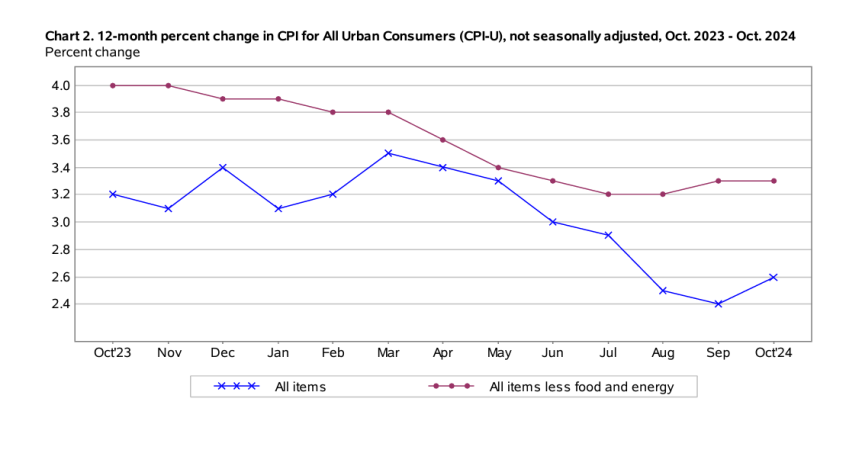
CHICAGO — The Consumer Price Index (CPI) report from the U.S. Bureau of Labor Statistics shows that inflation rose to 2.6% YOY in October, compared to 2.4% in September.
The rise follows the Federal Reserve’s significant 0.5-percentage-point rate cut in September, and another 0.25-percentage-point cut earlier in November.
For the 41% of Americans who said their No. 1 economic issue for the recent presidential election was inflation, this CPI report confirms that the Federal Reserve’s task of bringing inflation to 2% is not done yet.
“I keep hearing from the Fed that inflation is moving in the right direction; I am not seeing what they are seeing. Our own calculation using the level of the price index, shows an increase of 0.24% over the month or 2.97% on an annualized basis, up from an annualized 2.18% in September,” said Peter Rupert, Ph.D., and a professor of economics at the University of California, Santa Barbara. “The year-over-year increase was 2.58% in October, increasing from the 2.41% reading in September. Our preferred annualized trend measure also increase, from 1.98% in September to 2.31% in October.”
Here’s a breakdown of the different indexes, and the rises and falls (seasonally adjusted changes from preceding month) seen in October, according to the Bureau.
Related. Macroeconomic Factors That May Impact Trade Shows
- Energy Index: 0.0%
- Energy commodities: -1.0%
- Gasoline (all types): -0.9%
- Fuel oil: -4.6%
- Energy Services: 1.0%
- Electricity: 1.2%
- Utility (piped) gas service: 0.3%
- Food Index: 0.2%
- Food at home: 0.1%
- Food away from home: 0.2%
- All items less food and energy: 0.3%
- Commodities: 0.0%
- New vehicles: 0.0%
- Used cars and trucks: 2.7%
- Apparel: -1.5%
- Medical care commodities: -0.2%
- Services: 0.3%
- Shelter: 0.4%
- The rise in the Shelter index accounts for more than half of the monthly all items increase, according to the Bureau.
- Transportation services: 0.4%
- Medical care services: 0.4%
- Shelter: 0.4%
- Commodities: 0.0%
- Energy commodities: -1.0%
“The main reason that “core” inflation is used by the Fed and others is due to the fact that food and energy prices are very volatile and so are removed from the index. However, food and energy are large parts of the expenditure of households. So when households are looking at the prices of things they buy, obviously, food and energy play a large role. Food is roughly 13% of the total expenditures in an average urban budget and energy is a bit over 6%. The largest expenditure category is shelter at about 37%. While one can pick and choose what to take out, many of the measures have also shown increases, but others have not. For example, take food prices. The price index shot up quickly during/after COVID but the growth of prices has come down but have started to rise more recently,” Rupert said.
The CPI for all urban consumers rose 2.6% over the last 12 months, and the Bureau’s Real Earnings Summary revealed that real average hourly earnings for all employees increased 0.1% in October from September. Real average hourly earnings increased 1.4% from October 2023 to October 2024, seasonally adjusted.
“The bottom line is that inflation has come down over the past year or so, but many indicators are showing signs of increasing prices,” Rupert said.
Read Rupert’s full analysis of the October CPI report here.
The pictured chart is from the U.S. Bureau of Labor Statistics’ report.