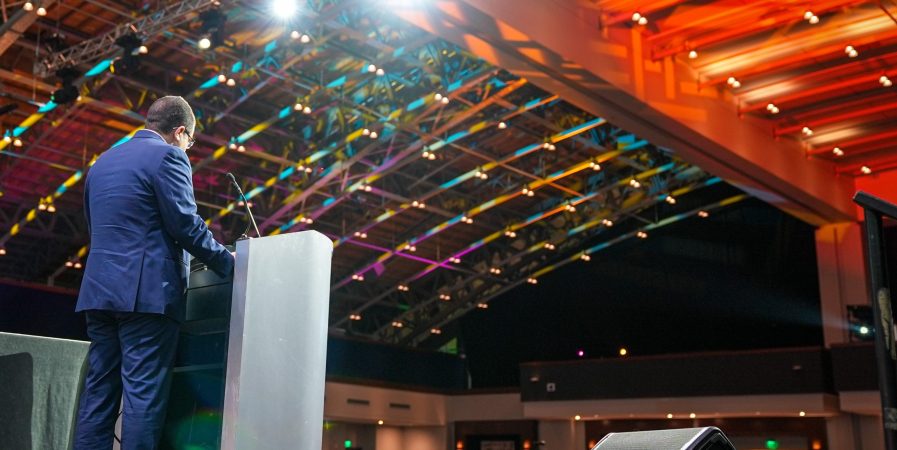
CHICAGO — The lights dim, the crowd hushes and a big-name speaker strides onto the stage.
Then, he phones it in with a polished, generic talk he’s delivered a dozen times before. By the time the applause fades, half the audience is mentally checked out and the other half has already left and is on the show floor.
Liz Lathan, CMP, Co-Founder and Chief Community Officer of Club Ichi, a social club for event industry professionals, has seen this scenario play out many times.
“The format isn’t broken, but the execution often is,” she said. “A great speaker who does their homework and customizes their content can still captivate an audience. The problem is the default to safe, forgettable presentations that leave professionals feeling their valuable time was wasted.”
Looking at the Data
New findings from Freeman’s latest Learning Trends Report confirm what many organizers suspect.
Only 47% of attendees say that general sessions contribute meaningfully to their overall event ROI. While roughly 60% still seek that unifying “part of something bigger” feeling, far fewer walk away with practical, applicable value.

Nearly 60% prefer industry experts and practitioners over celebrity speakers, and while 84% crave actionable takeaways, just 64% say they actually receive them.
According to the report, attendees are staring down rising travel costs and time away from the office.
Management teams, demanding clear ROI, are no longer content with vague inspiration. They all want ideas they can actually use.
Reimagining the Centerpiece
Beth Surmont, FASAE, CMP-Fellow, CAE, Head of Strategy and Design at 360 Live Media, a full-service events agency and a Smithbucklin company, believes the general session’s role has evolved, but too many events are still trapped in outdated delivery.
“It doesn’t work well when the general session is a predictable slot of housekeeping, typical opening remarks, sponsor messages and a speaker who gives generic comments,” she explained.
Surmont recommends framing the entire event around a “What, So What, Now What” narrative.
“Opening general sessions establish the landscape and priorities, while later sessions translate those ideas into action. People are still looking for moments of unifying connection,” she said. “But the general session has to be designed to be relevant and useful.”
John T. Kelley, Vice President and Show Director, CES®, at the Consumer Technology Association (CTA)®, sees enduring power in well-executed keynotes — when they deliver substance.
At CES, CEO-level speakers are expected to share their company’s vision, launch products and ground presentations in real-world applications.
“A traditional one-way keynote is still incredibly powerful, delivering meaningful insight, not just inspiration,” Kelley says. “The most successful conference sessions today feel less like a speech and more like a conversation with the industry.”

Breaking Through Inertia
Despite widespread recognition that change is needed — 69% of organizers agree general sessions must evolve according to the Freeman report — budget pressures and “the way we’ve always done it” thinking remain stubborn barriers.
Surmont points to mindset as the biggest obstacle.
“We let ourselves get trapped in the thinking that there is a model to follow,” she said.
Her solution often involves shorter, sharper sessions and reallocating resources toward relevance rather than pure star power — frequently at a lower total cost.
Lathan says that risk aversion is the main culprit. “Booking a big name feels safer than betting on a lesser-known expert who might deliver a truly transformative talk,” she said.
Lathan also calls for deeper collaboration.
“Speakers often want to do more. They want more interactivity, [and] more customization, but many feel like they need explicit permission,” Lathan observed.
What the Ideal General Session Looks Like
For the ideal general session, Surmont envisions a tight “state of the union,” a relevant expert perspective and a panel that distills everything into practical next steps.
She’d eliminate generic remarks, vague sponsor pitches or anything without clear relevance.
“If you can’t immediately state the relevance, it shouldn’t be on the stage,” Surmont said.
Lathan stresses speaker presence at the event before, during and after the session.
“I’d eliminate the stock keynote where the speaker flies in, speaks and disappears,” Lathan added.
She advocates for built-in interaction, frameworks and post-event tools that help attendees share insights back at the office.

Kelley emphasizes listening and experimentation.
CES continually refines its programming based on attendee data and recently added AI trainings, new tracks and hands-on demos.
“Evolving general sessions isn’t always about increasing budgets,” Kelley noted. “It can be about rethinking the experience.”
Finding a Stronger Voice
The future of the general session lies in moving beyond celebrity monologues toward practitioner-led, outcome-focused experiences filled with real-world examples and clear application.
By prioritizing relevance, interactivity and measurable value, organizers can transform these legacy centerpieces from underperformers into powerful drivers of ROI.
As Surmont puts it, “Every minute of an event delivers ROI. That usually means relevance, application or connection.”
General sessions aren’t dying — they’re evolving.
The organizers who adapt will ensure the big room regains its voice and its rightful place at the heart of the event experience.
Featured Photo Credit: American Transplant Congress 2024