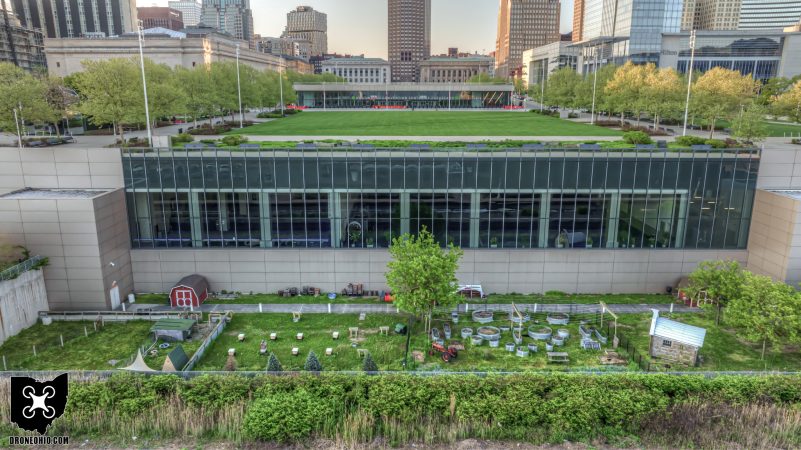
CLEVELAND, Ohio — The Huntington Convention Center of Cleveland refreshed its 19,000-square-foot urban farm, which has supplied fresh ingredients, supported pollinator health and showcased urban agriculture for more than a decade.
Its new features include:
- A small fruit-tree orchard, with a combination of approximately 12 cherry, apple and pear trees, replacing the farm’s pigs.
- Raised cedar planting beds, which will replace galvanized steel beds, to increase the farm’s growing capacity, enhance the visual appeal and make maintenance easier.
- A new chicken coop.
The farm provides extensive herb production and grows limited quantities of vegetables, including sweet potatoes, eggplant, carrots and tomatoes.
Trade Show Executive’s (TSE) Young Professionals Corner checked in with Michael Campo, General Manager of Huntington Convention Center of Cleveland at Legends Global, which manages the venue, and Jude Feyedelem, General Manager for Levy Restaurants at the Huntington Convention Center of Cleveland, to examine these updates and learn how urban farms are key differentiators.
A Timely Refresh
Feyedelem explained that the farm was part of the building’s original sustainability vision.
“During development, Levy Restaurants and the facility’s management team made a deliberate decision to extend sustainability beyond building design and recycling systems,” Feyedelem said. “The concept took shape when the project team identified roughly a quarter-acre of unused space from a former loading dock area. Rather than leave it dormant, that space was repurposed into an on-site urban farm, what is now known as The Real Farmville.”
These new features were identified through a collaborative effort between Legends Global and the Levy leadership team. As they evaluated the impact The Real Farmville has had on the convention center over time, the goal was to preserve and strengthen the elements that have proven most successful while evolving the overall experience.
Decisions were grounded in operational value and historical performance, leaning into what is currently working, what can be utilized more consistently in their culinary program and what would enhance the guest-facing experience.
The venue’s team built on what has already made the farm successful and made intentional improvements that would allow them to take the program to the next level, both from a product utilization standpoint and a visual, experiential standpoint for guests.
“At the same time, some of the existing infrastructure, specifically the original handcrafted chicken coop, has begun to show its age and is ready for a thoughtful refresh,” Feyedelem said. “This update also gives us an opportunity to evolve the farm in a way that better supports our operation. Shifting from pigs to a fruit tree orchard allows us to utilize more of what we grow in our day-to-day, smaller-scale food functions, while also enhancing the overall visual appeal of the space as guests look out over The Real Farmville. In addition, we are continuing to build on our herb and vegetable program, placing them in a more organized and visually appealing setting that will provide long-term sustainability and ease of maintenance. Collectively, these updates position the farm for both greater operational alignment and a stronger guest experience, which is why it makes sense to move forward at this time.”
Campo added that projects like the urban farm demonstrate that innovation can happen anywhere.
“What began as an underutilized piece of land became an opportunity to create something meaningful for our guests, our community, and the environment,” Campo said. “For young and up-and-coming professionals, it’s a reminder that some of the best ideas come from looking at existing challenges through a different lens. Sustainability and a willingness to think beyond traditional approaches will continue to play an important role in the future of our industry. Don’t be afraid to ask, ‘What if?’ — those questions often lead to the most impactful solutions.”
Feyedelem added that this was the right time to act because sustainability has never been more front and center in our industry, and this allows the venue to bring that focus to life on-site in a tangible, guest-facing way.
Related. Trade Show Executive’s Acquisition Survival Guide
Benefits of an Urban Farm
Campo shared that an onsite urban farm is a visible and memorable way to demonstrate sustainability in action, and differentiates venues by creating a direct connection between the facility, its food and its environmental initiatives, allowing guests to see sustainability at work.
“The urban farm enhances the attendee experience by providing fresh, locally grown ingredients for our culinary team to incorporate into our menu offerings, while demonstrating our commitment to sustainability,” Campo said. “As demand continues to grow for environmentally responsible event venues, the farm serves as a unique amenity that differentiates our property in the marketplace.
“Beyond its operational benefits, the farm is a powerful sales tool. During site inspections, it creates an unexpected and memorable experience for prospective clients. Most visitors do not expect to find a working urban farm in the heart of downtown Cleveland, making it a distinctive feature that leaves a lasting impression. The farm reinforces our sustainability initiatives, strengthens our brand story and helps position the venue as an innovative and responsible choice for meetings, conventions and special events. This in turn helps us secure more opportunities and more clients that might not have considered Cleveland.”
This urban farm also displays the creativity and ingenuity of the venue’s team.
“By transforming an underutilized piece of land into a productive green space, we have created an amenity that supports our sustainability goals while providing benefits to the community and the environment,” Campo said. “The farm enhances the guest experience, promotes local food production, supports pollinators and serves as a tangible example of our commitment to responsible stewardship of this asset. Few venues can offer attendees the opportunity to experience a working urban farm onsite, making it a unique selling point that reinforces our brand as an innovative and environmentally conscious destination.”
Feyedelem added that The Real Farmville is also an opportunity for educational engagement.
The venue has hosted interactive field trips where students were able to come on-site, harvest vegetables directly from the soil and visit the venue’s kitchen to use those same ingredients in a dish.
“Seeing that full-circle experience, going from the ground to the plate in real time, was incredibly impactful,” Feyedelem said. “It not only reinforces the farm-to-table concept, but also creates a memorable, hands-on connection to food, sustainability and hospitality that resonates well beyond the visit itself.”
To get more articles like this, sign up for TSE’s free Young Professionals Newsletter.