WASHINGTON D.C. — Three industry events centered around education, advocacy and information sharing held back-to-back brought top-level leaders to Washington, D.C., last week.
Lippman Connects’ Exhibition & Convention Executives Forum (ECEF), the Exhibitions & Conferences Alliance (ECA) Legislative Action Day (LAD), and the all-new Global Policy Forum, hosted by MAD Event Management, ECA and UFI, The Global Association for the Exhibition Industry, provided industry leaders with executive-level learnings, opportunities to impact policy and candid conversations around sustainability efforts.
Trade Show Executive (TSE) was on the ground for these three events to unpack bold ideas being shared and the industry’s positioning within the policial sphere.
Lippman Connects’ ECEF
Starting off the week in the capital was Lippman Connects’ ECEF, which also celebrated its 25th anniversary this year. With another year of record attendance, the 2026 event also marked another sold-out edition.
“We promised that the 25th anniversary program would not be a walk down memory lane,” said Sam Lippman, President of Lippman Connects. “Instead, we focused, as we always do, on what’s coming around the next corner and how event executives can prepare and thrive. Layered with activities that fostered top-to-top relationships, the program delivered insights to a record audience of 276 leaders.”
TSE’s Takeaways from ECEF’s Programming:
- When it comes to designing learning experiences at events, organizers need to lean into fewer, high-impact sessions, scheduling time for reflection and networking, and adding structure for more peer-to-peer interactions. (5 Key Data Points in 5 Minutes, presented by Sam Lippman)
- You don’t have to work globally to have a global mindset. Global thinking begins with awareness, not expansion; and exposure to different perspectives gives leaders a cutting edge. (A Global Mindset Pays Off Even if You Operate Locally, presented by Edwina Kulego, Vice President of Global Business Development & Growth, Fashion at Informa Markets)
- Selling based on exhibitor/sponsor outcomes elevates the value of participation; focus on ROI-first thinking and eliminate offerings that aren’t delivering real value for your customers. (The Profitability of Restraint: Why Leaving Money Behind Pays Off, presented by Bob Hughes, Vice President, Supplier Relations, Expositions and Meetings at NACS)
- When independent organizers and associations partner to produce an event, one of the most important steps to take is to set a strategy early, give clearly defined roles and responsibilities, and empower functional teams to execute and problem-solve through relationship-mapping to avoid decision paralysis, items falling through the cracks and tensions from building. (Building Better Together: Lessons in Strategic Partnerships, presented by Brandy Rand, Vice President and Market Leader, Hospitality Group at Questex; and Kiersten Pearce, Senior Vice President, Strategic Initiatives and Conferences & Events at the American Hotel and Lodging Association)
- ECA 2.0 is the organization’s new initiative focused on expanding the impact of its advocacy and increasing engagement across the industry. While ECA focuses on advocacy efforts centered on taxes, tariffs, talent and travel, industry leaders are encouraged to get involved with the organization. (Punching UP: Why We Need ECA 2.0, presented by Fernando Fischer, President, Americas at RX, and Chair of ECA)
- Event organizers need to keep creating opportunities for young people to feel connected with the industry and see the long-term impact investment in Gen Z can have on their own businesses as well as their event portfolios. (First Impressions: Annabelle Project Mentees Speak, presented by Sam Lippman, and Diamond Vaughn and Joshua Oloriegbe, recent graduates of Jarvis Christian University and mentees with The Annabelle Project)
- AI agents are officially here. In working with AI, it is important to tell the model to ask clarifying questions until it is 95% certain it can get the task done successfully to get the best outcomes possible. When it comes to integrating AI into an organization’s workflows and systems, leaders need to create a culture of continuous adaptation to allow AI agents to work. (The Agentic Enterprise: What Every Leader Needs to Know, presented by Shelly Palmer, CEO of The Palmer Group)
- In conversations around renewals between exhibitors and organizers, exhibitors are putting a greater focus on the quality of conversations at the event and what the event organizer did to help set them up for success prior to the event, like sharing attendee data and providing more guidance around transitional moments in the programming rather than just expo floor hours. (What Attendees Actually Want From Your Show (It’s Not the Swag), presented by Rajul Shah, GM and Global Head of Sales – Growth Products for Zoom)
- The need for personalized learning at events is growing as attendees crave more actionable and interactive learning experiences; providing recommended sessions and exhibitors to see while at the show based on an attendee’s interests can have an outsized impact on their experience. Offering various formats for learning — and networking — like roundtables, keynotes, one-on-ones, workshops and others can appeal to different kinds of learners who have different event objectives. (Adding Information Value Across the Event Experience, presented by Ken Holsinger, Senior Vice President, Industry Research & Insights, The Freeman Company; Kimberly Hardcastle, Chief Strategist, The Freeman Company; Rebecca Sausner, CEO, Yotta; and Christine Murphy Peck, Chief Global Learning Officer, ASIS International)
ECA LAD
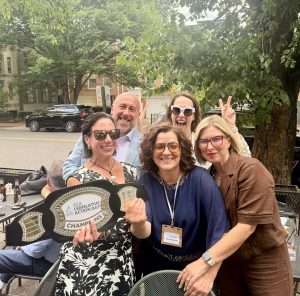
ECA once again welcomed a record-breaking crowd to Capitol Hill for its day of advocacy. This year, 226 event professionals took part in the program, advocating for the events industry around priorities like opposing tariffs, securing funding for the expansion of Pell Grants and supporting the reauthorization of the Terrorism Risk Insurance Act.
Throughout the day, more than 130 meetings took place in Congressional offices, but advocacy efforts year-round are still needed to help drive the change the industry lobbied hard for on the Hill.
“LAD is a one-of-a-kind opportunity to directly advance our shared policy priorities in Washington, D.C.,” said Tommy Goodwin, President and CEO of ECA. “That said, industry leaders and advocates can still get involved anytime through the ECA Advocacy Network, which has everything that you need to take action from your office, your phone or even the show floor.”
Also happening alongside LAD was a competition that has continued generating energy — the annual LAD Scavenger Hunt. This year’s winner was the team from Connecticut.
Global Policy Forum
The inaugural Global Policy Forum, an invite-only event, welcomed 24 industry leaders to the Army & Navy Club to have high-level discussions around global policy issues impacting events, including trade tariffs and global sustainability efforts.
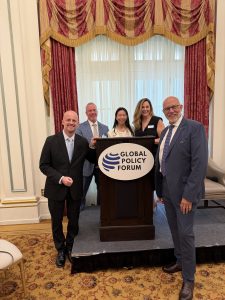
The event was a joint effort between ECA, UFI and MAD Event Management, and brought together leaders in international business, policy and media to discuss current challenges, ongoing efforts and how event industry leaders can work together to drive growth for the sector. Alongside the official programming and panel discussions, the intimate setting proved successful in generating authentic dialogue between attendees on the topics at hand.
Part of the event’s programming focused on the United States-Mexico-Canada Agreement (USMCA) and the relations between the U.S. and its closest neighbors. Leaders conceded that the U.S.’s negotiations with Mexico were going better than with Canada, and that the current U.S. administration is likely to continue pursing trade tariffs without Congressional involvement.
The tensions between nations have led Canada to see a rise in regional events in certain sectors as professionals opt to not travel to the U.S., while Mexico takes a wait-and-see approach.
While the conversations were candid around the challenges arising due to the trade tariff situation remaining volatile, the overall feeling in the room was optimistic as leaders agreed that leaders should see borders as bridges rather than barriers.
On the topic of sustainability, Chris Skeith, OBE, CEO of UFI, spoke to the importance of collaboration on standard writing to ensure the business events industry has a seat at the table for the future of regulations and policy decisions.
Other leaders encouraged each other to start on sustainability initiatives before they have everything figured out, because sustainability is seen as more of a business objective to upcoming generations than before.
Attendees also discussed the importance of continuing to work on sustainability regardless of current regulations because the political pendulum will swing back to put it in focus eventually. Ultimately, there was consensus in the room that sustainability is more than just the right thing to do; it provides a competitive business advantage.
The Global Policy Forum put on full display the idea that despite the challenges around trade tariffs and sustainability, the events industry sits atop a goldmine of success stories that can be emulated across borders, and with deeper, more intentional collaboration and information-sharing, significant progress and alignment are possible.
To get more events industry news, subscribe to TSE’s free e-newsletter on LinkedIn or through your email.