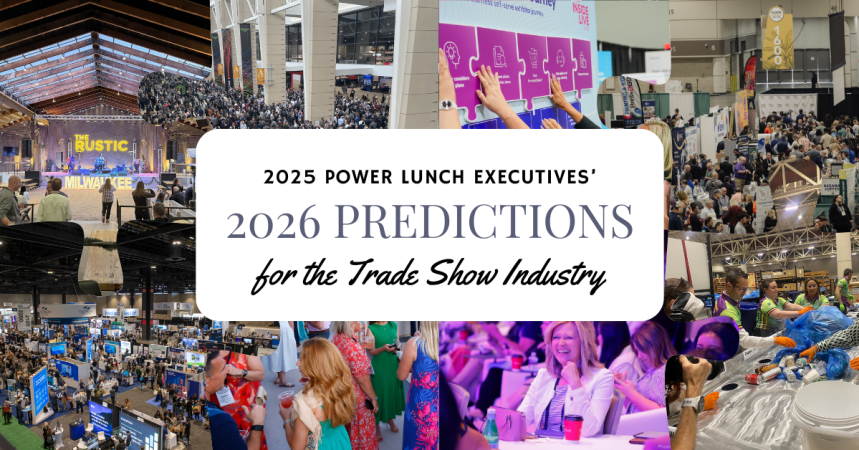
CHICAGO — As we enter the new year, Trade Show Executive (TSE) checked in with some of its Power Lunch executives of 2025 to find out what these powerhouse leaders think is on the horizon for the trade show and events industry.
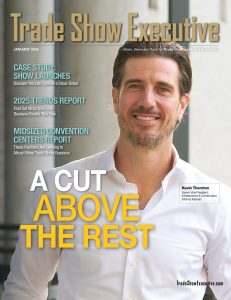
Kevin Thornton, Senior Vice President, Infrastructure and Construction, Informa Markets
I predict that 2026 will see lower interest rates acting as a significant tailwind, driving increased investment and activity across the industry. I believe this momentum will build throughout the year, with its impact becoming more noticeable by the end of 2026 and continuing into 2027.
I also foresee AI continuing to play a big role, with productivity gains for organizers through the use of internal AI tools and increasingly hyper-personalized experiences for attendees. Additionally, I expect to see both current and new exhibitors bringing more AI-driven technologies to the market, tailored to the unique needs of each sector.
It will also be interesting to see if there is a resurgence of smaller, niche events, as I think they provide a unique opportunity to cater to highly specialized audiences.
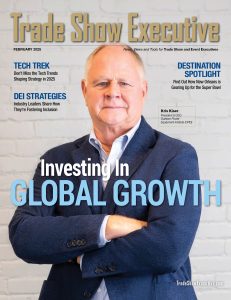
Kris Kiser, President and CEO, Outdoor Power Equipment Institute
1. Collaborative partnerships — More co-location partners, education opportunities and social events that bring like-minded groups of attendees together. We see expanded partnerships with associations and subject matter experts — in our world, groups like Landscape Management magazine, the Association of Outdoor Lighting Professionals, the Pool and Hot Tub Alliance — to provide training and certification.
2. More peer-to-peer engagement opportunities at large events — We continue to leverage our host city’s iconic and historic venues for our opening and closing events — Churchill Downs for our opening reception, and Louisville’s Paristown Point district for a new closing party, giving attendees one-of-a-kind experiences.
3. Structured roles and opportunities for influencers — Our industry podcasters and social media influencers are a key part of Equip Exposition, both as promoters, and participants in sessions like Energize and the Morning Show at Expo.
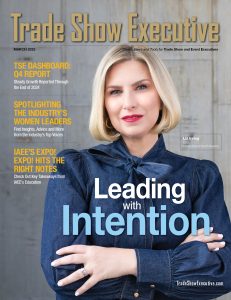
Liz Irving, CEO, Clarion Events North America
As we look toward 2026, our industry continues to evolve at a rapid pace, constantly driven by changing customer expectations, technological advancements and the need for deeper engagement. Staying ahead requires bold thinking and a relentless commitment to innovation. I see three major trends shaping our future, and they all ladder up to a single imperative: creating stronger connections and delivering enhanced value for every stakeholder.
1. Experience ROI will define success. Events can no longer be measured by square footage or attendance alone. Organizers must design with outcomes in mind, outcomes that focus on connecting people, products, solutions and information in ways that feel purposeful and frictionless. This means curated journeys, immersive activations and real-time analytics that show not just traffic, but engagement quality and behavioral insights that predict lead conversion. When we deliver experiences that drive measurable business impact, we elevate the entire industry.
2. AI-enabled personalization and operational excellence will continue to transform how we work. Technologyisn’tjust a tool — it’s a catalyst for efficiency and creativity. AI-ready data infrastructure will allow us to unify CRM and marketing automation, creating intelligent workflows that start at lead generation and extend through customer service. This will reduce friction, improve targeting and increase renewal rates — all while empowering our teams to focus on what matters most: delivering exceptional customer experiences. Operational excellence becomes the foundation for innovation.
3. From event producers to year-round growth partners. Face-to-face willremainthe heartbeat of our industry, but the role of organizers is expanding. We must think like ecosystem builders: creating always-on content, building first-party data assets, and developing recurring revenue streams such as subscriptions. This isn’t about simply adding digital extras; it’s about reframing our strongest brands to deliver 365-day value. By doing so, we create trusted communities where engagement and connections never stop.
At the core of these trends are our people and culture. At Clarion, we’re investing in skill-building and empowering teams to embrace common ways of working, data, and digital capabilities that open doors to new possibilities. When we combine human ingenuity with cutting-edge tools, we unlock a future where trade shows aren’t just events — they’re engines of innovation, driving growth and connections.
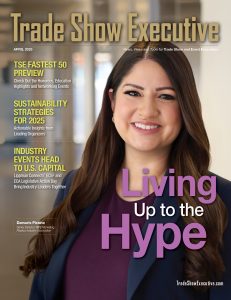
Damaris Piraino, Senior Director, NPE Marketing, Plastics Industry Association
I anticipate AI will continue to play a pivotal role in advancing personalized pre-show and on-site communications for attendees and exhibitors, as marketers leverage AI-driven insights to better understand audience preferences and deliver tailored experiences. Session recommendations, individualized itineraries and intelligent chatbots will become standard practice instead of one-size-fits-all agendas and static event communications.
Additionally, the continued success of podcasts will remain a powerful driver of high-quality registrations, as influencers are seen as trusted voices within the industry.
Sustainability will remain one of our top priorities. After successfully achieving our sustainability goals at NPE2024, we are dedicated to inspiring and supporting vendors and exhibitors in adopting similar practices and making more environmentally responsible choices.
Mike Karsting, Senior Vice President, Events, World Pet Association
Prediction 1: We’ll See More Consolidation Across the Industry
Exhibitors and attendees are being more selective about where they spend their time and resources, and that’s pushing all of us toward fewer shows that offer more value. What I’m hearing from companies is pretty straightforward: They want efficiency, strong ROI and shows that deliver a high-quality audience. Instead of spreading their budgets across multiple events, they want to focus on the ones that are truly moving the needle for their business.
It’s the same thing from the attendee perspective. Time is precious, travel is expensive and people want to get everything they need in one place. If they can discover new products, meet with suppliers, learn from experts and build relationships at a single event, that’s a win.
My view is that consolidation doesn’t decrease opportunity but concentrates it. When you put more energy into a handful of flagship experiences, everybody benefits. It creates a better show, a better audience and a better outcome for the industry.
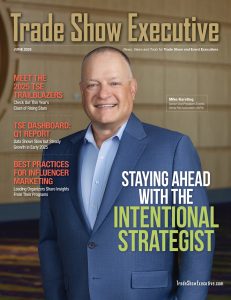
Prediction 2: 2026 Will Look a Lot Like 2025
I don’t think 2026 will bring a dramatic shift. And in my mind, that’s a positive thing. We’re in a period of steady, predictable growth. After a few years of uncertainty and pandemic recovery, the industry is stabilizing, and that gives exhibitors, organizers and attendees a chance to breathe and plan smarter.
What I’m seeing is incremental innovation instead of big swings. People are refining what works, improving experiences and being thoughtful with budgets. That consistency lets exhibitors prepare earlier, allows organizers to invest in the right areas and gives attendees a clearer sense of what to expect. For me, 2026 is a year to keep building on what’s working. Not flashy, not drastically different; just dependable progress.
Prediction 3: We Need One More Year for a Full Bounce Back
Recovery is happening, and it’s encouraging, but I think we still need a bit more time to fully come back to pre-pandemic levels. This year will be strong, but 2027 is when I expect to see the industry firing on all cylinders again. Attendance is climbing, exhibitor budgets are opening up and confidence is improving with each event. But not every segment is rebounding at the same pace. Some companies are still cautious. Some are trying to rebuild teams. Some are feeling the impact of the economic climate.
I look at 2026 as a bridge year. We’re going to see momentum, no question. But the real breakthrough will happen when all those upward trends align. By 2027, I believe we’ll see fuller halls, bigger booths and a level of energy that really feels like the industry is back. And I’m optimistic because everything we’re seeing right now is pointing in that direction.
Stephanie Jones, CAE, CMP Fellow, SEPC, Managing Director, Event Strategy, Water Environment Federation
1. Price Transparency: There isa strong desirefor a more straightforward approach to conducting business and predicting expenses related to trade shows and events. Exhibitors increasingly seek price transparency when assessing potential opportunities, aiming to better understand and control their costs.
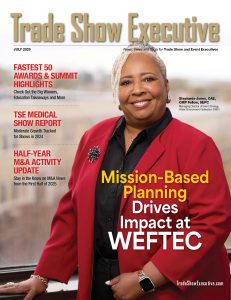
One effective solution to address these concerns is packaged or bundled offerings. By providing a single, all-inclusive price for exhibitors, organizers can eliminate unexpected costs and streamline the purchasing experience. This approach not only reduces uncertainty but also makes the process of participating in trade shows and events much simpler and more appealing for exhibitors.
2. Sustainability as a Core Value:Sustainability is no longer just an optional feature or a marketing tool for events. It has become essential for achieving event success. Today, sustainability stands as a core organizational value, and attendees are increasingly expecting event organizers to prioritize it. This shift reflects a broader demand for events to leave a meaningful and positive legacy that extends beyond the conclusion of the event.
Event participants now expect organizers to focus on creating legacies that are environmental, social and cultural in nature. The emphasis is moving beyond merely reducing the carbon footprint of events. There is a growing expectation for events to contribute positively by fostering social legacies, respecting and honoring cultural diversity, and strengthening the communities that host them. Ultimately, the goal is for events to give back to their host locations, ensuring they contribute to, rather than extract from, these places.
Melissa Medina, Co-Founder and CEO, eMerge Americas
1. Events will win on personalized, year-round community building, not just annual moments.
In Miami, we’ve proven that when you build a real community, everything else follows: the energy, the momentum, the innovation. eMerge Americas has shown that people don’t just want to attend an event; they want to belong to an ecosystem. In 2026, audience acquisition and retention will hinge on creating year-round value, not just one marquee moment.
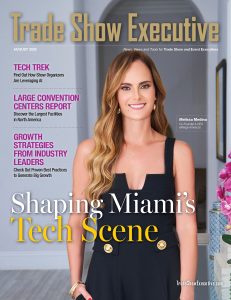
I believe more conferences will follow this model, offering curated touch points throughout the year, like intimate meetups, vertical-specific programming, global roadshows and digital experiences that keep communities connected and engaged. For eMerge Americas, that means deepening our presence across AI, quantum, health, finance, and national security, and delivering a personalized, meaningful attendee experience long before anyone walks through the doors.
2. 2026 will be the year events become personal journeys
I believe 2026 will be the year attendees stop asking, “What does this event offer?” and start asking, “What does this event offer me?” At eMerge, we design our show floor and programming so every interaction has purpose: from curated networking lounges and one-on-one investor-founder meetings to themed vertical zones where people can discover peers, partners, and collaborators. The future belongs to experiences that feel personal, curated and unforgettable. They are moments that resonate so deeply they’re impossible not to share. When you give each person a journey that reflects their goals and passions, and intentionally design spaces for connection and discovery, you create not just attendance, but belonging. And belonging is what brings people back and creates community.
3. Importance of in-person events in such a digital world
I believe that physical, in-person events and experiences are going to become more and more relevant and important in such a digital world. Elon Musk recently said, “When digital media is ubiquitous and you can just have anything digitally essentially for free, then the scarce commodity will be live events.” In my opinion, the digital economy is incredibly powerful, which just makes live events that much more meaningful and valuable.
Mark Tester, Executive Director, Orange County Convention Center
As the trade show industry looks ahead to 2026, several emerging trends are poised to reshape how events are designed, delivered and experienced. First, we are seeing events trend younger, with Gen Z increasingly flooding the event landscape. This generation is seeking authentic, personalized experiences that go beyond traditional programming. Networking, commerce and learning remain central, but they must be delivered in ways that feel genuine and tailored.
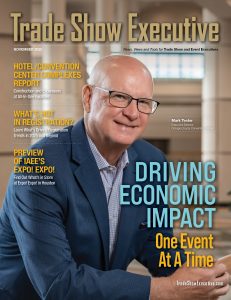
Personalization will continue to be a driving force. Attendees expect curated experiences that reflect their interests and values, and venues play a critical role in enabling organizers to deliver that.
On the economic front, tariffs are expected to settle in 2026, finally answering the question of their true impact on business. For venues, including our own expansion project, tariffs have been a factor in budgeting and planning. As clarity emerges, organizers and facilities alike will be better positioned to forecast costs and make strategic decisions.
As we move into 2026, these trends highlight the need for adaptability, innovation and a focus on authentic connection. The trade show industry’s ability to evolve alongside attendee expectations will determine its success in a rapidly changing world, and venues, like the Orange County Convention Center, are committed to leading that evolution.
Brian Pagel, Commercial Executive Vice President, Emerald
As we look toward 2026, our industry is entering a new phase of innovation — one defined less by experimentation and more by intentional, practical application. Technology will continue to advance quickly, but the real shift is how intentionally organizers are using data in real time to design stronger experiences and clearly demonstrate value. In practice, this means taking immediate action — refining programming, sharpening audience focus and adjusting onsite execution as engagement and feedback evolve.
Ultimately, trade shows that lead in 2026 won’t be defined by novelty alone, but by how effectively they blend innovation, insight and measurable outcomes.
One of the key trends shaping the industry is the need for in-person experiences that deliver outcomes digital channels can’t. Smartphones and digital platforms are no longer just tools for attendees — they’re constant alternatives competing for attention. Data consistently shows that what draws people to live events is the opportunity for meaningful, human interaction. In response, organizers must design attendee experiences that prioritize connection, collaboration and discovery — creating environments where attendees feel invested, engaged and motivated to participate.
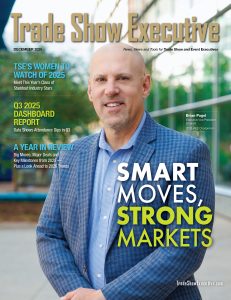
Looking ahead, AI and real-time analytics are becoming operational necessities rather than experimental tools, moving from insight generation to decision confidence. Rather than relying on static reports or post-event analysis, organizers now have the ability to interpret engagement quality and connection outcomes as they emerge — enabling more strategic, data-based decisions about where to invest attention, resources and effort in the moment. Used well, these tools don’t automate decisions; they strengthen judgment, enabling teams to make smarter, faster decisions that improve outcomes across the event ecosystem.
Finally, these shifts are redefining how organizers think about scale, sustainability and engagement beyond the show floor. Global fragmentation and evolving regulatory and sustainability expectations demand more localized, informed strategies, while audiences increasingly expect value that extends year-round. The organizers who succeed in 2026 will be those who design for participation, focus on what truly matters, and use technology to elevate — not replace — the power of face-to-face connection.