CHICAGO — Freeman released the second part of its Freeman Trends Report, “Unpacking XLNC: The Future of Adult Learning at Conferences and Trade Shows,” focused on the learning component of the XLNC framework.
One of the key findings from the report, which reflects a nearly balanced 50-50 response rate from trade show and conference attendees, is that attendees experience learning on the show floor and in conversations with peers — not just in formal sessions. In fact, attendees say they want to spend 54% of their time learning in any other area of the event outside of the conference or general session rooms.
“The big surprise in the data wasn’t that attendees would like that unstructured piece; it was that if they were asked where to spend their time, they prioritized it,” said Ken Holsinger, Senior Vice President, Industry Research & Insights, at Freeman. “Now, it’s not by a lot. There’s still a balance to be had, but we need to bring more structure to the unstructured.”
Key Data Points
Data from the new report highlights the importance of approaching this “unstructured” learning with intentional design to be effective and meet the expectations of attendees.
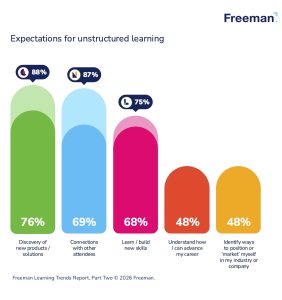
- 76% of attendees expect unstructured learning to provide discovery of new products/solutions (88% of commerce-focused attendees); 69% expect connections with other attendees (87% of networking-focused attendees); 68% expect to learn and build new skills (75% of learning-focused attendees).
Understanding why your attendees are coming to your event can help you deliver the kinds of learning experiences they value. For example, commerce-focused attendees need opportunities for product discovery on the expo floor.
- The top three indicators of value for unstructured learning are: discovery of new products and services (50%); insights that I could pass on to coworkers and my team (40%); direct applicability to my day-to-day work (40%).
“There’s a big opportunity around this product discovery element. The value proposition for unstructured learning is key,” Holsinger said. “This whole series culminates in this big, broad opportunity that this unstructured area and product discovery should be considered and trained as a learning environment.”
- Short-format learning was ranked as one of the least valuable elements of unstructured learning, with only 20% of attendees saying it ranks in their top three considerations.
“One of the things that is popular right now among organizers is to say the problem with learning is that it’s too long. We addressed that in the first report; it’s not about their attention span. It’s about outcomes,” Holsinger said. “How should we design for the right pieces? And we tried to probe at that a little bit. The problem isn’t the length of the sessions; the problem is the design and the intent and the content. Poorly developed and delivered content can be short or long.”
Related. Freeman’s Learning Trends Report Reveals What Attendees Value at In-Person Educational Experiences
- Attendees find networking and exhibitor conversations to be more valuable than general sessions, keynotes, conference room sessions or expo theatres.
While 60% of attendees find the structured formats for learning valuable, a higher percentage of them value learning from different sources, highlighting the need for more intentional design to create opportunities for this kind of information exchange.
- 96% of organizers say they have no dedicated staff member responsible for networking.

When it comes to designing unstructured learning, event organizers typically do not have someone or team clearly responsible for the experience. This represents an opportunity for organizers to provide clear ownership, facilitate meaningful networking that serves as an educational opportunity, and capitalize on the overall learning potential of an event.
- 68% of attendees say expo theatre sessions provide a different atmosphere for learning that compliments conference room learning, while 67% say they are differentiated from the learning that takes place in conference rooms, and 60% say they allow them to connect with other attendees and experts more effectively than conference room sessions.
Expo theatres give attendees an opportunity to discover products and solutions naturally, get hands-on demonstrations and connect with peers and experts, directly tying back to what the report found attendees value in learning experiences.
- 64% of attendees said that exhibitor-delivered expo theatre sessions prompted them to visit an exhibitors’ booth, while 72% said they helped to connect them with an exhibitor SME.
Expo theatre sessions can be leveraged to help increase booth traffic and meaningful engagement for exhibitors, helping to increase their ROI.
- 75% of attendees say demonstrations or hands-on trials of products and solutions help them learn best when it comes to addressing their challenges and areas of interest. Sixty-six percent said discussions with SMEs help them in the same area.
The need for more education and strategizing support is seen in the finding that while 81% of exhibitors say they prioritize leaving attendees with take-home value that they can implement or consider in the future, only 61% of attendees say they find exhibitors effective at doing so.
“What most exhibitor education is, is logistics. Here’s how you save money on X, Y and Z, and get your freight in,” Holsinger said. “The issue here is you need to train exhibitors on how to show up better for face-to-face marketing. We must take ownership of the face-to-face marketing channel. … Kimberly Hardcastle and myself have been doing [exhibitor education] for some of the biggest events and biggest customers, and I’m blown away that some of the biggest brands in the world are coming to these session and scribbling notes on hands-on demonstrations, subject matter experts, in-booth theatres and how they should talk to the next generation.”
- 30% of attendees view sponsored sessions positively, while 54% have neutral feelings on corporate sponsorship.
While organizers may have preconceived feelings on “pay-to-play” sessions, 60% of attendees say sponsorship does not impact their attendance of a session if it is on a topic they are interested in.
“[This finding] should unlock some opportunity or an organizer,” Holsinger said. “Number one, it goes from cost to revenue potentially. The cost of paying an outside influencer to come speak is flipping … there are opportunities, and big brands are looking for thought leadership. They want placement and they want to change the point of view of their brand, their product, their category.”
- 50% of attendees say they are likely to attend an industry trends session delivered by exhibitor/provider staff/expert, while 51% say they’d be likely to attend if the session was delivered by an industry influencer and 41% said they would be likely to attend if it was provided by event organizer staff.
Overall, attendees place high value on expertise, regardless of what organization an expert is affiliated with. Organizers that provide opportunities for exhibitors to showcase that expertise, through things like sponsored sessions and expo theatre sessions, will add learning value to attendees and deliver greater ROI for exhibitors.
Action Items for Organizers

The report also lays out six clear action items for organizers based on the findings.
- Assess attendees needs using the XLNC framework before the event.
- Embrace the expo floor as a learning channel and bring more intentionality to the floor.
- Help exhibitors to tailor their content to present thought leadership and deliver take-home value to attendees.
- Provide lead-tracking tools outside of the booth to help exhibitors capitalize on the qualified leads they could connect with through learning opportunities.
- Leverage clearly labeled sponsored sessions and set exhibitors up for success by helping them put knowledgeable people on stage.
- Elevate the exhibitors’ Know Before You Go to provide best practices on product demonstrations and conversational tips.
You can find and download the full report here.
To get more events industry news, subscribe to TSE’s free e-newsletter on LinkedIn or through your email.