The impact of the Trump Administration’s new policies has begun to be felt by international trade shows and business events.
Several countries have posted travel advisories, warning their citizens about traveling to the U.S., including China, Canada, The United Kingdom, Finland, Germany, Ireland, France, Denmark and the Netherlands. Recent media reports of the protests in Los Angeles have only exacerbated the concerns.
Stories of ordinary travelers and event attendees being detained or turned away at the border have stoked the fear even more: the high-profile case of 35-year-old Canadian actress and entrepreneur Jasmine Mooney, who was held by U.S. immigration for nearly two weeks; a French researcher who was denied entry due to his criticism of President Trump’s policies; two Palestinians who had planned to visit the Bay Area for a series of interfaith events and had their visas canceled and invalidated.
These cases also included travelers from countries that are long-time U.S. allies, such as France, Germany and Canada.
Others are being denied visas, such as prominent LGBTQ+ activist Phyll Opoku-Gyimah, who was trying to travel from the U.K. to Washington, D.C. for the WorldPride 2025 Human Rights Conference.
On June 9, Trump’s travel ban went into effect, targeting foreign nationals from 12 countries: Afghanistan, Myanmar, Chad, the Republic of the Congo, Equatorial Guinea, Eritrea, Haiti, Iran, Libya, Somalia, Sudan and Yemen. Heightened restrictions apply to people from Burundi, Cuba, Laos, Sierra Leone, Togo, Turkmenistan and Venezuela.
U.S.-Canada Tensions Escalate
Tensions between the U.S. and Canada due to tariffs and Trump Administration threats have had the most noticeable impact.
At Flight Centre Travel Group Canada, business travel between the two countries has declined by close to 40% year-over-year, Managing Director Chris Lynes told Global News. “We definitely had an immediate influx of cancellations for conferences that were meant to be in the U.S.,” he said. “One of our banking customers cancelled six programs.” Destinations included New York, Dallas, Washington, D.C., and Las Vegas.
Related. Global Exhibitions Day 2025: TSE Explores the Power of Trade Shows with Power Lunch Stars
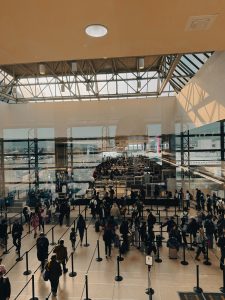
Other conferences are moving from the U.S to Canada, especially in the scientific and academic fields. The Northwest Cognition & Memory (NOWCAM) Conference, to be held in early May at Western Washington University in Bellingham, Wash., relocated to Victoria, Canada.
Stephen Lindsay, a psychologist at the University of Victoria and one of the meeting’s organizers, told Nature of his concern that attendees would decide not to attend “if doing so entailed crossing the border. I also plan to avoid travel to the U.S. until relations improve.”
Global Impact
The impact extends to attendees from around the globe, and is being felt across all industry sectors, from financial and insurance to tech and manufacturing.
The InCyber Forum, Europe’s largest annual cybersecurity conference, recently postponed what would have been the organization’s first-ever U.S. edition. It was expected to draw 5,000 attendees to San Antonio next week.
“The current policy and economic environment remains both challenging and unpredictable, and the decision to pause the San Antonio conference is consistent with similar decisions made by several other U.S. conferences whose success is impacted by the broader geopolitical and policy landscape,” the organizer said in a written statement.
Even Informa’s successful National Restaurant Association Show, held in Chicago in late May, felt the impact. “Informa is seeing strong growth across its business, including continuing demand for live B2B events. For the National Restaurant Association Show, it was a successful 2025 edition,” said Tom Cindric, President of Exhibitions for Informa Connect Foodservice Group. “We had higher exhibitor and sponsor participation, strong attendee satisfaction scores, and our rebooking exhibitor percentage is in the mid-80s, demonstrating the quality and value of the overall experience. After several years of growth, international participation was slightly lower this year, reflecting changing dynamics in the food services market, as well as some uncertainty around tariffs.”
ECEF Addresses the Issue
The topic was front of mind at the Lippman Connects Exhibition & Convention Executives Forum, held May 28 in Washington, D.C.
Managing Director, Group Travel, U.S. Travel Association Kevin Hinton emphasized the importance of positioning the U.S. as open for business and addressing the concerns plaguing international visitors.
Keynote speaker and Consumer Technology Association® CEO and Vice Chair Gary Shapiro called the situation a “quasi-crisis” threatening international events including his own, CES®, which is held every January in Las Vegas.
More than 40% of CES attendees are international, he said. “I am paranoid about what we can do differently to make them feel comfortable coming to our show.”
Photo Credit: Unsplash