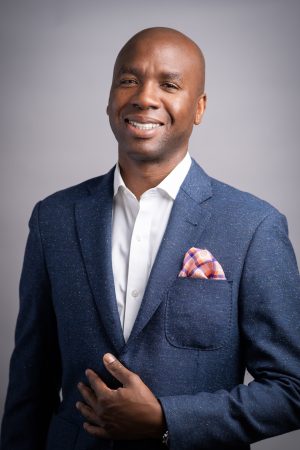
CHICAGO — February marks Black History Month — a time meant to acknowledge, remember and celebrate the contributions of Black and African Americans to U.S. history and society. In honor of this month, Trade Show Executive (TSE) is shining a spotlight on some of the industry’s influential Black professionals. One such professional is Glenn Charles, Jr., President and CEO of Chicago-based Show Strategy, a general services contractor that works on trade shows, art fairs and other live events and experiences globally. He also is the Principal and Managing Director of GCJ Management, LLC, a full-service planning, project management and trade show/event production company. With more than 20 years in project and construction management and 15 years in the live events and exhibitions production space, Charles is leading Show Strategy to new heights.
TSE caught up with Glenn to talk about his career, future plans for Show Strategy and the power and importance of participation and fostering diversity in the industry.
MADDY: How did you get your start in the trade show and events industry?
GLENN: My background is that I’m an architect. I started off working for Merchandise Mart Properties in the early 2000s, and they, at the time, were the largest producer of trade shows and events in the country. I was under the construction team and eventually got promoted to run their trade show division.
I managed the trade shows and events all around the country, and then in 2008 the market started crashing, and MMPI started right sizing the company. Around 2010, the trade show industry really started feeling the effect, and that made its way to my office. The tradeshow division had to right size as well.
I was met with a couple options. I ultimately decided to start my own business in 2011, supporting and managing trade shows. Then in 2017, I started Show Strategy, which is the contracting side of our business. Although I am a service provider, a contractor, I actually spent the early part of my career on the show management side, and so I have two businesses. GCJ Management is a company that manages trade shows and events, and Show Strategy is a contractor.
MADDY: At Show Strategy, we can see a six-step plan outlined that includes Listen, Analyze, Strategize, Launch, Show and Optimize. Can you talk us through that process a bit and how this helps you to best serve clients?
GLENN: I think one of the biggest misconceptions about service providers is that we only provide a service as requested. Generally, in our space, most event managers and show producers have something they know that they want to do and who to work with. So, the first step in our process is to sit down and we actually do a good amount of listening and downloading, trying to get a true understanding of what they want to do.
The value add is, we take that data, analyze it and we go back to the clients and say, ‘Okay, here’s what you told us you wanted, and here’s the reality of that. However, here are some alternative solutions to what you think you want.’ And that’s when the strategy part kicks in.
Once we get past strategizing, and all the scope of work is confirmed, now we’re doing the work, and we build the event. The reverse part of that is on the back end, and we do a really deep dive into what worked, what didn’t work and how do we make it better. We see what some of the other considerations are and if a client has the same thought process now that’s it’s over.
We try to go in and optimize every moment and analyze every moment. Sometimes people assume that it was a good experience, and that people are happy with the end result. We don’t make assumptions as it relates to the client experience nor the end-user experience, so that we can make the proper adjustments.
Since we’re doing this over multiple years, it’s really getting our understanding of our clients. It’s important to understand where a client is going and what type of content they’re going to have. We seek to partner with companies who have a long term, fully vested interest and commitment to their events. A lot of effort, time and energy goes into planning an event. We try to invest our time and resources into brands and corporations, to create partnerships that have longevity.
MADDY: Reflecting on the last year, what has been a big highlight for Show Strategy that you’d like to share?
GLENN: Building the DNC [Democratic National Convention] was the highlight of our business. It is by far the biggest thing that we’ve ever done. The DNC property helped scale and magnify our business — we tripled the size of our warehouse and doubled employee headcount. We acquired additional equipment, which gives us capacity to support other events.
We’re having conversations with potential clients who now know Show Strategy has the scale to potentially do their convention or trade show. The DNC definitely validated us in a way that hopefully in the long term puts us in a position for similar opportunities.
MADDY: Diversity is important to you and your company, as it’s evident even on your about page where “We hope to one day diversify the trade show and events industry,” is shared as part of its mission. Can you talk more about what that looks like and means to you?
GLENN: First and foremost, obviously I’m a diverse individual. When I came into the industry, Juan Teague, [Chief Executive Owner and Founder of Juan and Only Events] and I were in the room full of people that didn’t look like us. When we met each other, we both were like, “Wow, I didn’t know you were in the industry.” We’ve collaborated on projects ever since, with DNC being our biggest collaboration and opportunity for both of our companies.
The industry is evolving now and you’re starting to see a lot more people of color, but when I say diversity, I don’t just mean race. I mean the youth as well, because our industry is older. You don’t see a lot of progression or a collective succession plan. People are just now starting to talk about succession planning, but it’s still a big gap in terms of the youth transition into our space.
I’m trying to magnify the industry to everybody, and selfishly, I’m trying to get minorities into the space because it’s a career that is under-represented in terms of how successful you can be, from the front office to the labor forces. The labor trades — these people are making good money building shows and meeting people from all around the world.
My life changed when I changed some of the environments and circles I used to hang around. My first career job was at a hotel. I was a bellman and valet parker. I was seeing people come out of the hotel with badges on all the time, and I never made the connection that they’re going to a convention. I never made the connection that it’s what I’m going to do one day. To now be in this space, I appreciate it a lot more and I think diverse people will too — particularly the youth.
The industry wants to add elements of “cool,” but they’re missing the most important add, and that’s young people. They want to use technology, but they can’t grasp it without adding the youth, and it’s not going to work if you don’t fully embrace this new culture into the industry. I want to see more people that look like me, and yes, I’m in a position where I can hire people that look like me and give them the opportunity to change their lives and build a career in a space they didn’t normally know about.
We can all do a better job at creating a succession plan with young people, and they don’t think how the older generations think. This generation has been diverse their whole lives, so it’s important to include them in our space at a more rapid pace.
Related. TSE’s PCMA Convening Leaders 2025 Recap
MADDY: Since entering into this space, have you identified some challenges you’ve seen in terms of representation? How can the industry at large better support those facing these challenges?
GLENN: I would say the biggest challenge is the openness for change. Everybody knows who the major players are in the space, and some of them dominate in a way that if you were in any other industry, they wouldn’t allow it. And there’s this notion that people think they only have a choice for certain vendors. But then you’re going to pay more than you can afford and it’s not sustainable.
I would love to see, and I think there should be, what I’d call a mentorship plan, similar to what they have in construction. You have Walsh Construction, a ginormous general contractor, and they partner up with smaller contractors, minority-owned, women-owned, it [the ownership] doesn’t matter. But with those larger firms, they help them scale and partner with them on projects they wouldn’t normally get because at the end of the day they recognize there’s enough money for everybody.
I wish there was more diversity, meaning options. I wish people’s ideas for options were more diverse, but that can only happen if people start being intentional about making it clear that there are more solutions and more vendors that can provide. You see the same people bouncing around from company to company, and they continue to do business with each other instead of reaching out and incorporating other businesses.
We’re going to see a change when people embrace the fact the some things need to change. Then we will start to see new ideas, new methods, new people and new contractors and technology. That’s when we’re going to start seeing a measurable shift in our business.
MADDY: In a time when we’re seeing broad pushback on DEI initiatives in society, why do you think it’s still necessary in the live events sector?
GLENN: I think about it like this: looking at hospitality as a whole. Let’s start at the airport. The bag check employees, they’re diverse people, from diverse backgrounds. At the hotels, the bellman, the valet parkers, the front desk receptionist, they’re diverse people. And you see this through the entire hospitality experience. Go to a restaurant, and who’s cleaning your table and cooking in the kitchen? They’re diverse people from diverse backgrounds.
The entire front-end of the hospitality experience is led by people from diverse backgrounds from all over the world, women include because women are a part of diversity. So how could you not have that same continuity throughout and all the way up?
For myself, I have the top-down, bottom-up approach. I can now make decisions that create change in my space. And then you also have that bottom-up approach, so if I say I’m going to help you, you have to help somebody else. It’s literally a requirement for me to help you, because I’m going to put you in a position, and you may not be able to put somebody in that same position, but once you get to a point where you’re able to change or put someone in position, that’s your requirement. That’s how I got into my space — somebody gave me an opportunity and said they’d help me, but I need to help somebody else, and that’s been part of my success.
MADDY: I know Show Strategy is a member of a number of industry associations. How do you feel those have been in terms of being a resource for your team? How has membership to these benefitted the business and your own professional career?
GLENN: I’ll be totally honest. For years I was a member, but I never participated because I honestly just didn’t see the value. There was a big lack of diversity and a bigger lack to let somebody new into those spaces. Over the last couple of years, post-COVID, I started to interact with people like Julie Kagy, [Executive Director, ESCA] and Eric Kincaid, [VP Sales, Choose Chicago] and various leaders in the industry. The common statement was, people were looking for companies like mine and individuals like me, but I needed to participate in the industry. So, I made a decision to say, you know what, this is what I need to do to go to the next step in my business, help build my team and go where I want to go in my career.
So, I started participating and oddly enough, they all were right. There’s continuity that’s happening with relationships by me starting to participate. We are in a people-based and relationship-based business. I do believe that’s an essential component to getting business, outside of just [people saying], “He’s a minority, I’ll give it to him,” because that’s not what I’m looking for. I want to build valuable relationships and then put people in a position to say, “I want to help this guy, I believe in his story, his brand and his business. They do great work. Let’s help push his business forward.”
And that’s how people become successful in any space. When people see talent, they try to help you magnify your talent, and so I’m trying to put myself in a position for people to see my talent and my Show Strategy’s potential.
MADDY: What are you looking forward to in 2025?
GLENN: I’m excited about all the potential opportunities and relationships that I’ve developed. I’m excited about the relationships I’m building that I know, ultimately, will put me in a position for business opportunities down the road.
I’m a relationship guy; I’m a foundational builder, so I’m excited about building foundations with people, institutions and brands within our industry.
I’m really excited about continuing to support the industry and participate; it literally has me pumped. PCMA Convening Leaders blew me away, and I had a great time at IAEE’s Expo! Expo!, so I kicked my year off with some events that I’ve historically not attended. But I did and I’m like, “How come I didn’t do this before?” I met so many cool people and got some really good content.
MADDY: Is there anyone you’d like to give a shout out to in this series?
GLENN: I want to give a shout out to my wife, Jennifer Charles. She owns GCJ Hospitality Resources. It’s a staffing and hospitality agency. She provides temporary staffing solutions for shows and events around the country.
She puts the battery in my back every morning. It’s so great to have a partner that’s in the industry because she understands the time sacrifice and commitments required to support and execute projects efficiently and effectively.
She’s added a lot of value to me as an individual and definitely on the professional side. I’m very proud of her and what she’s doing with her business. She’s providing staffing for the NBA All Star game in a couple of weeks. She’s been doing some really cool stuff and is kind of on the same business journey that I’m on.
Want more content like this? Subscribe to Trade Show Executive’s weekly newsletter for the hottest news, case studies and thought leadership in the industry.